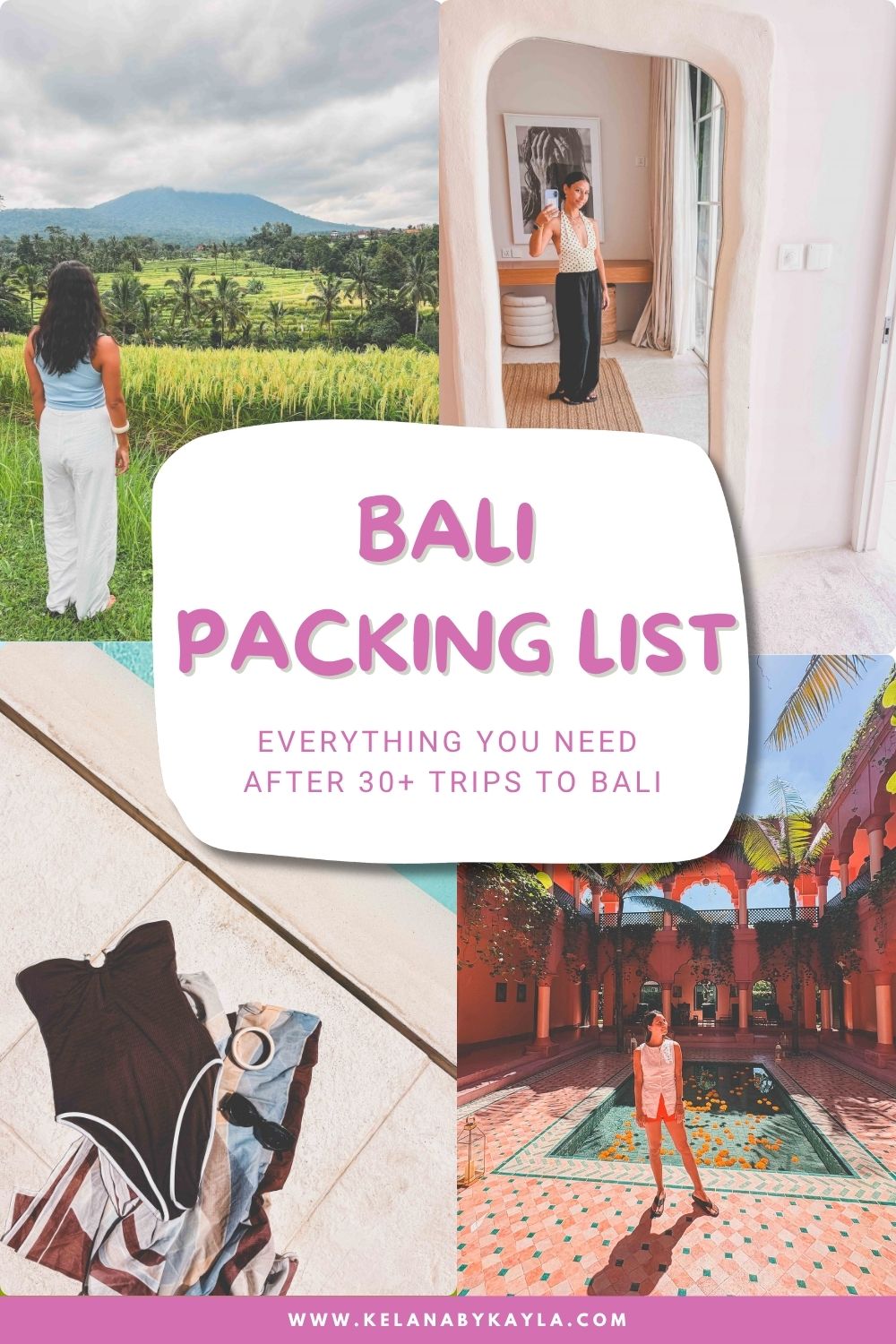
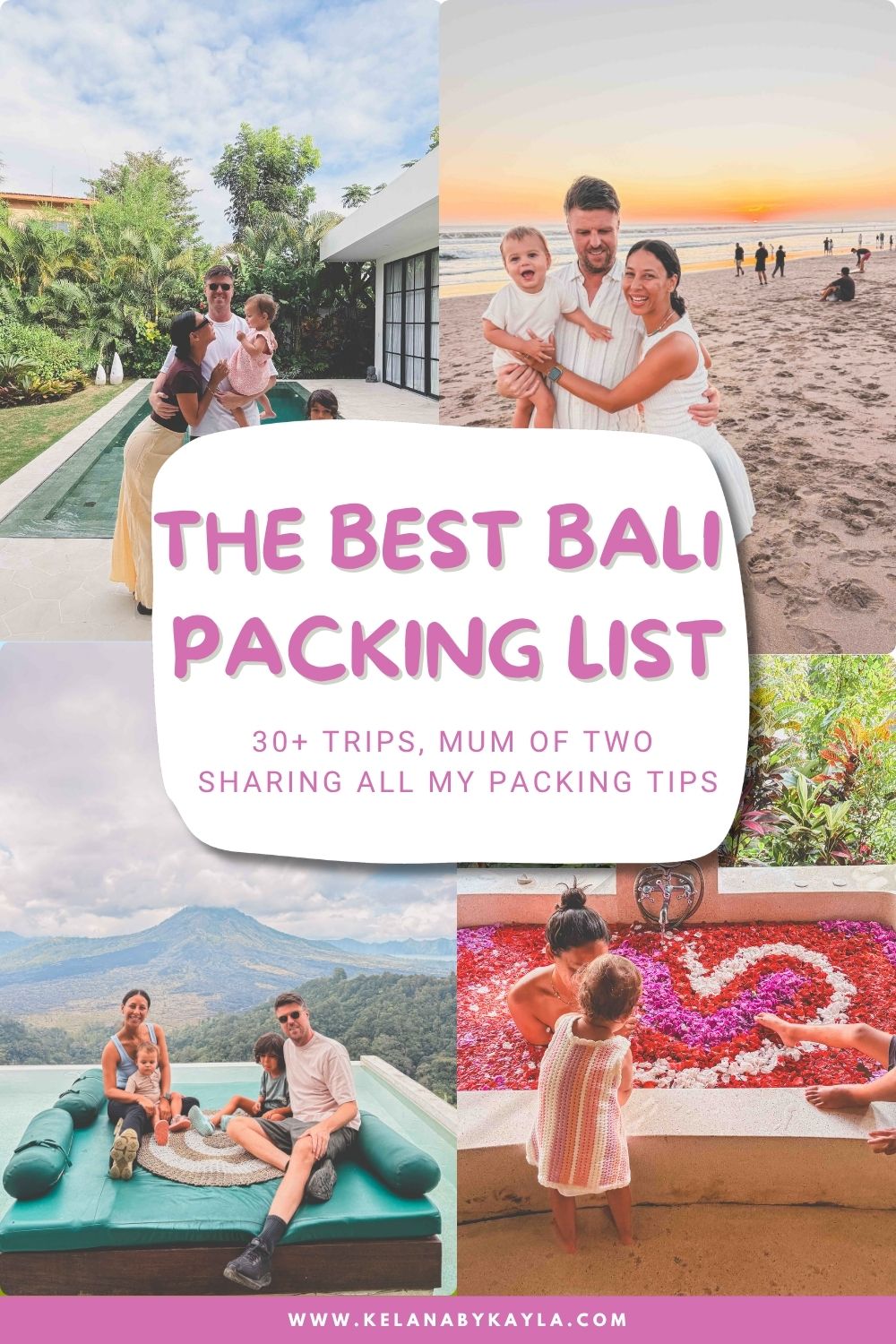
HHere’s the truth about packing for Bali: most people overpack, half of what they bring they never touch, and three things they genuinely needed they left at home.
After more than 30 trips to Bali (solo in my twenties, as a couple, pregnant, with a baby, with a toddler, and now with two kids under five) I’ve gone through every version of packing for this island. I’ve hauled way too much on early trips. I’ve also arrived without the one thing that would have made a 2am moment with a sick toddler infinitely less stressful. These days I’ve got it down to a system that works whether I’m travelling solo for a long weekend or taking the whole family for two weeks across five regions.
The most important thing to know before you start: Bali is incredibly well-stocked for most things you might forget or run out of. Pharmacies (apoteks) are everywhere. Laundry costs next to nothing, typically IDR 15,000–25,000 per kilo, which means you genuinely only need four or five days of clothing for any length of trip. And the shopping is exceptional, so leave room in your suitcase for the return journey. The things worth bringing from home are the things that are either unavailable, unreliable in quality, or genuinely inconvenient to source mid-trip.
That’s the filter this list runs through. Everything on here is something I’d actually pack. Nothing is filler.
One note for families: I’ve flagged baby and toddler items throughout, but I’ve also grouped them in their own section, because packing with young kids is a different discipline entirely and deserves its own attention. If you’re still working out where to base yourself, start with my Bali itinerary and my guide to the best areas in Bali, because where you stay changes what you pack.
The quick Bali packing checklist
If you only have two minutes, this is the short version. The detail and the why sit in the sections below.
- Passport (valid 6+ months), e-visa confirmation, tourist levy receipt, travel insurance details
- 4–5 days of lightweight, breathable clothes
- A sarong or scarf and a top that covers your shoulders for temples
- Swimwear (2–3 sets), a hat and sunglasses
- Reef-safe sunscreen and mosquito repellent
- Flip-flops, comfy walking sandals and one pair of shoes that can get muddy
- A light rain jacket or poncho
- Universal adaptor (Bali uses two-pin Type C/F plugs) and a power bank
- Basic first-aid kit and any prescription medication in original packaging
- A small dry bag or waterproof phone pouch
- An eSIM set up before you fly
- Spare space for shopping on the way home
Before You Pack: Sort These First
Before you open a suitcase, there are a few things to lock in online. These take minutes and save hours. We also have a Bali Planning Checklist that will help you plan your full Bali Itinerary.
| Item | What it is | Where to sort it |
|---|---|---|
| Indonesian e-Visa | Apply online before arrival — faster and same price as the visa on arrival queue | evisa.imigrasi.go.id |
| Bali tourist levy | IDR 150,000 per person — pay before you land at lovebali.baliprov.go.id | lovebali.baliprov.go.id |
| Travel insurance | Non-negotiable — medical costs in Bali can be significant. We use SafetyWing for family trips. | Safety Wing Travel Insurance |
| Airalo eSIM | Download and activate before you board. Connected from the moment you land — essential for Gojek, Google Maps, and everything else. | Get your Airalo eSIM here |
| Passport | Must be valid for at least 6 months beyond your return date. | Check it now, not the week you fly |
| Gojek app | Download and set up your payment before you arrive — you’ll need it from the airport | Download free on iOS/Android |
| Customs declaration | ndonesia has had an online customs form for arrivals. Rules change, so check the current requirement before you fly. |
💡 Tip on the eSIM: I can’t overstate how much easier this makes arrival. You step off the plane, open Gojek, book a car, and you’re moving. No SIM card queues, no airport WiFi hunting. We’ve used Airalo on every trip for the past three years and it’s the single best pre-departure purchase.
Tip on saving these documents: I keep a printed copy of our passports, e-visa, accommodation bookings and insurance in the front pocket of our carry-on, plus a photo of each on my phone. Phones die, and immigration doesn’t care that yours is at 1%. It looks old-school and it has saved me from a lot of stress.
What to Wear in Bali: The 4-Day Rule
Laundry in Bali is cheap, fast and everywhere. A kilo of clothes washed, dried and folded costs IDR 15,000–25,000 (roughly $1.50–$2.50 AUD) and usually comes back the same day or the next morning. That means you need four to five days of clothes maximum for any length of trip. Not ten days, not two weeks’ worth. It’s the single most useful piece of packing advice I can give.
The second most useful is fabric. Bali is hot and humid all year, so cotton, linen and loose rayon will keep you comfortable, while anything synthetic and fitted will have you peeling it off by 10am. I stick to loose, light-coloured pieces, and I leave the jeans at home every single time.
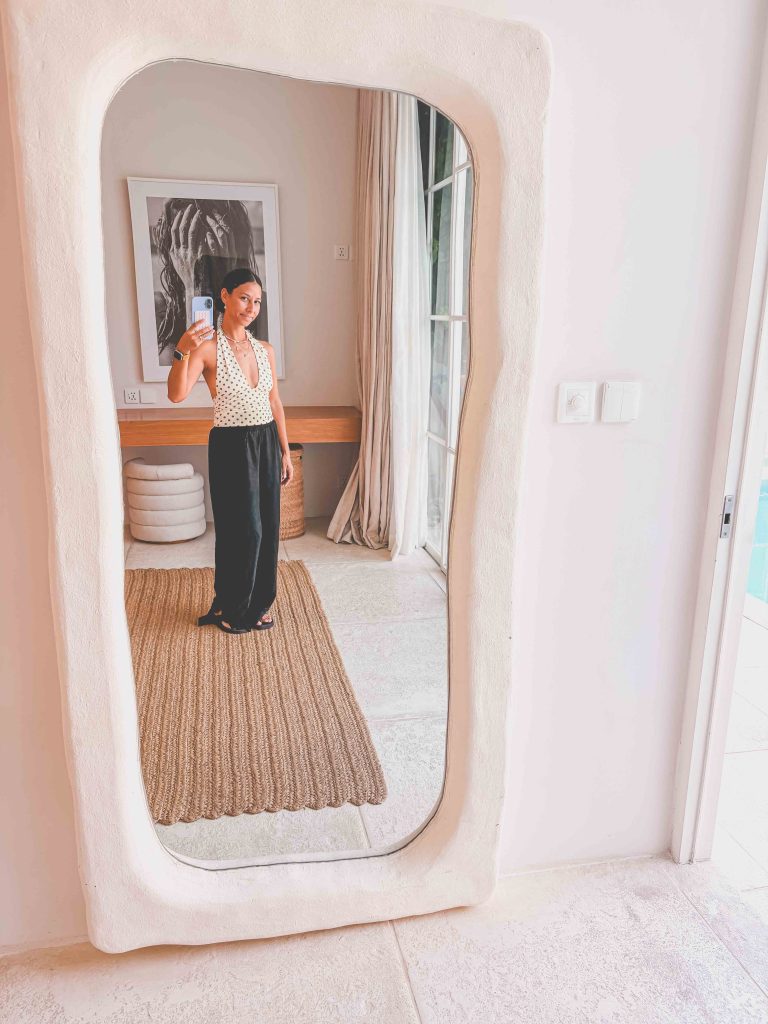

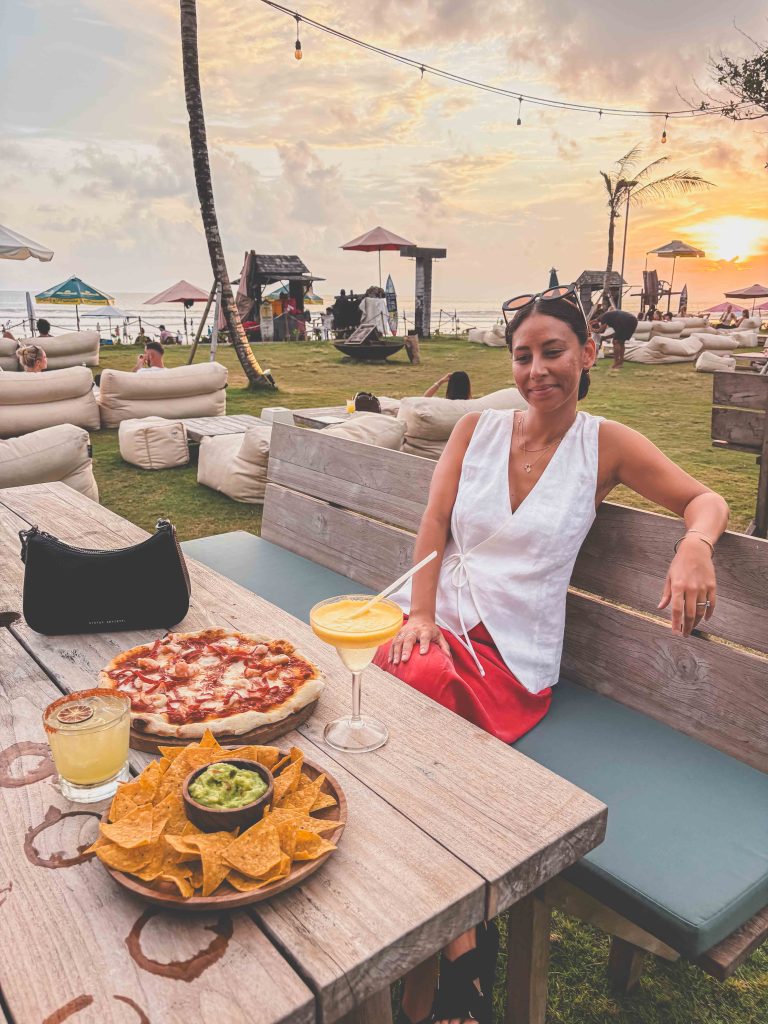



Tip on laundry: Ask your hotel or villa what they charge before you hand anything over, because some resorts price per item rather than per kilo, and it can add up fast. A local laundry (look for the signs saying “laundry kiloan”) is the cheap option. I put anything delicate in a mesh bag and ask for it not to be tumble dried.
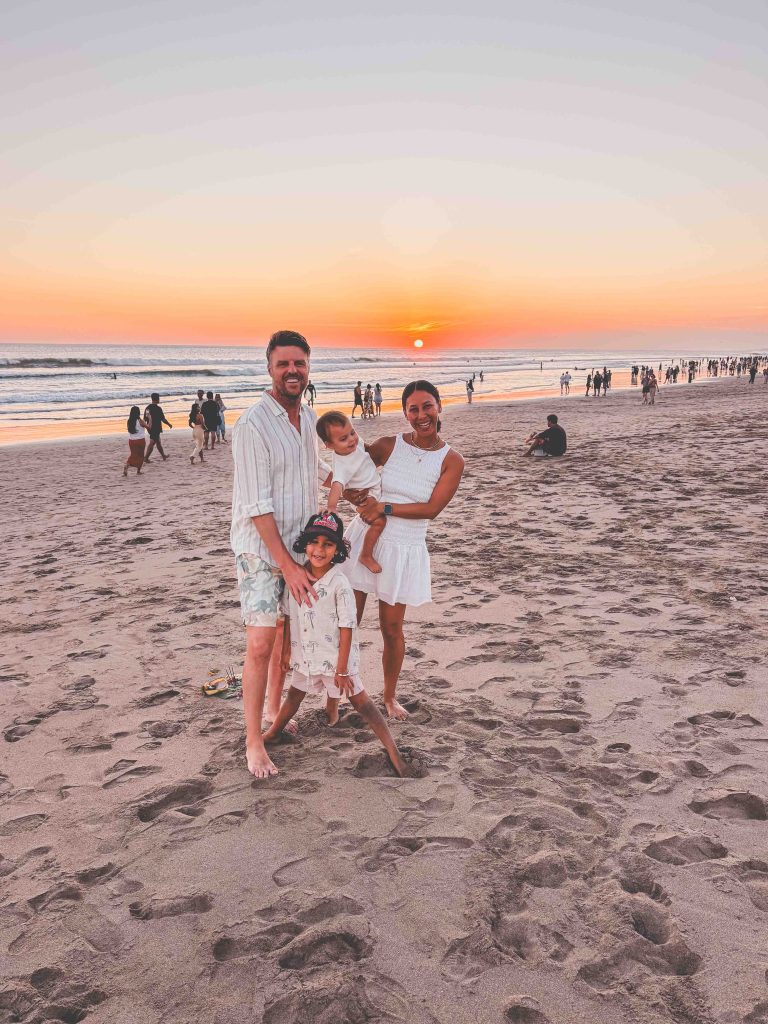
Tip for family trips: With two kids I do a laundry run every three or four days, not at the end. Kids go through outfits at a rate that makes the 4-Day Rule more of a 6-outfit rule per child, mostly thanks to pool, sunscreen and food.
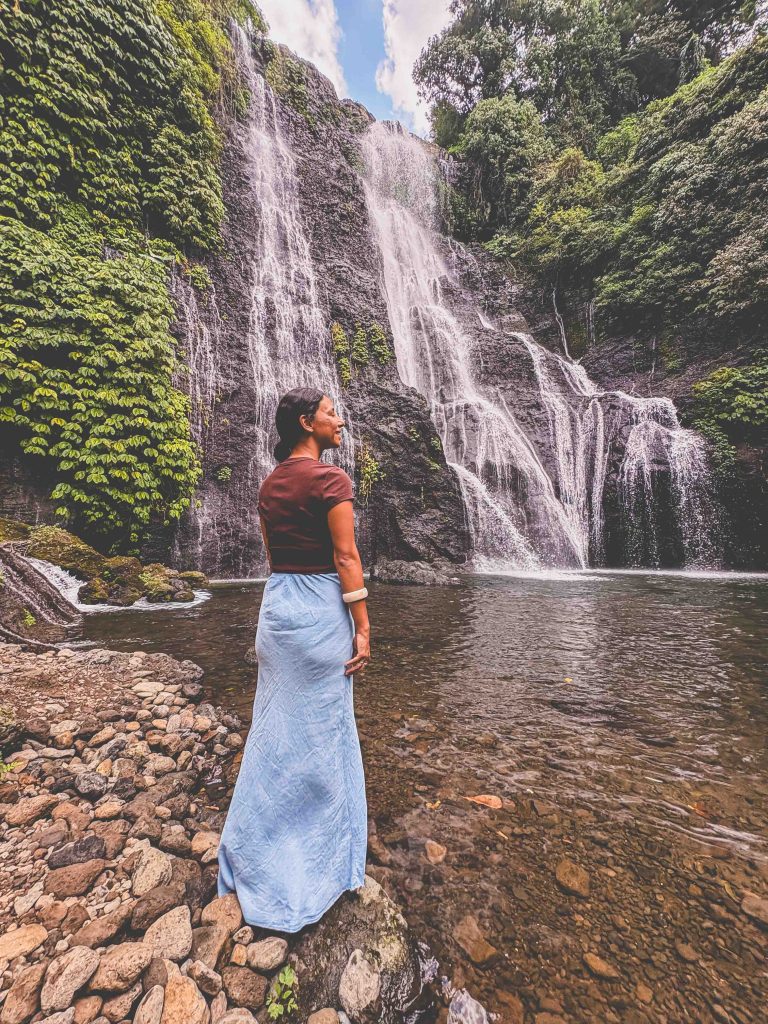
I really love Nudy Lucy Cupro Skirts and Pants. I have so many colours of the cupro skirt, they are perfect because you can wear them casually and then dress them up for night. If you want to get really creative, they also double as a dress. I wore my blue one like this when we went to Teja for our anniversary date night. Teja is one of the most amazing Uluwatu restaurants – I highly recommend it.
Other brands I love for Bali – Elce ( Bali Brand), Dissh, Uniglo for Tshirts, Twoobs shoes (so comfy),


Clothing checklist (per adult, any trip length)
- 4–5 lightweight tops or tees (cotton or linen)
- 2–3 pairs of shorts or a mix of skirts
- 2–3 summer dresses, or 1–2 lightweight pants (linen or loose cotton)
- 1 smarter outfit for dinners in Seminyak, Canggu or Nusa Dua
- 1 lightweight long-sleeve top or cardigan for air-conditioned restaurants and cooler evenings
- 1 light rain jacket or poncho
- 1 sarong or scarf (it doubles as temple cover-up, beach wrap and picnic blanket)
- 5–6 sets of underwear and 2–3 bras (pack more if you’re active)
- Lightweight sleepwear
- 1 set of activewear if you plan to do yoga, gym or runs
- 2–3 swimsuits (see the beach and pool section)
- Socks for one pair of closed shoes
- 1 hat
Men’s version: swap the dresses for 2 extra pairs of shorts and 1–2 collared or button-up shirts for dinners. Board shorts do double duty as swim and casual wear.


One Trip, Three Climates: Packing for Beach, Rice Fields and Highlands
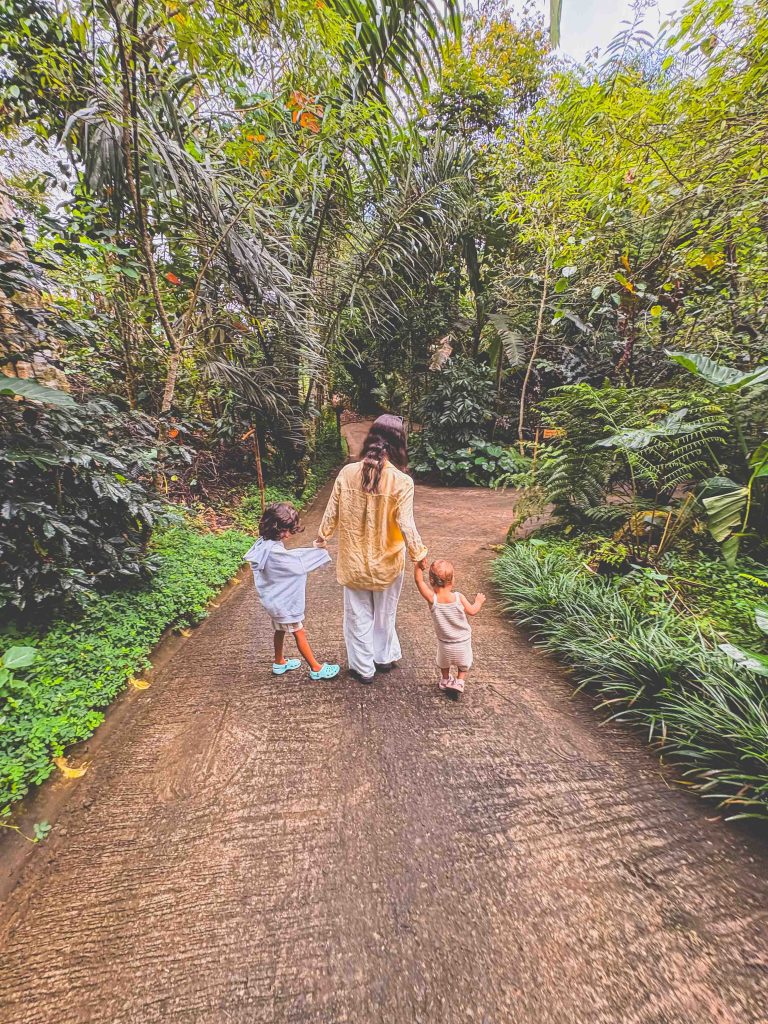
Most packing lists treat Bali as one hot, sunny place. It isn’t. A typical trip for us runs from the beach heat of Canggu or Uluwatu, to the rice terraces around Ubud, then up into the hills of Sidemen or Munduk where it’s greener, damper and a lot more atmospheric. You can do all three with one suitcase, you just need to know what to add.
The seasons matter too. The dry season runs roughly April to October and the wet season from November to March. Dry season means clearer skies and better views, but the wet season is lush and often quieter, and the rain tends to arrive in sharp bursts rather than all day. We visited Sidemen in May, which is technically dry season, and it still rained on two of our four days. So I pack a rain layer every single time, whatever month it is.
Tip: If you’re adding a highland stop to your Bali itinerary, put the warm layer and the sturdy shoes in the top of your bag. Mornings in the hills can feel properly cool, and rice-field walks and waterfalls mean wet, slippery paths.

| Where | What it feels like | What to add |
|---|---|---|
| Canggu, Seminyak, Uluwatu | Hot, humid, breezy at the coast | Hat, reef-safe sunscreen, beach bag, flip-flops |
| Ubud | Hot days, humid, sticky after rain | Light long sleeves for mozzies, walking sandals |
| Sidemen, Munduk, Kintamani | Cooler, damper, misty mornings | Light jacket, closed shoes with grip, poncho |
| Nusa Lembongan, Nusa Penida | Sunny, exposed, windy on the boat | Dry bag, rash vest, motion sickness tablets, sturdy sandals |
| Waterfall days | Wet, slippery, muddy | Water shoes or old runners, quick-dry clothes, a change of clothes in a dry bag |
Tip for the boat to Nusa Lembongan: The fast boat can be choppy and everything gets splashed. Pack your phone and passport in a waterproof pouch and keep your day bag small. My Nusa Lembongan guide covers the beaches and where to stay, but the packing rule is simple: if it can’t get wet, it goes in a dry bag.’
Shoes, Swimwear, Beach and Pool Gear
Shoes: three pairs is plenty. You’ll live in flip-flops, but Bali is rough on feet. Footpaths are uneven or missing altogether, there are steps down to half the best beaches, and a rice field walk or waterfall can turn a pair of shoes into a mud story. I take one pair of flip-flops, one pair of comfortable walking sandals that stay on in the rain, and one pair of closed shoes I don’t mind ruining. If you’re doing the Sidemen or Munduk waterfalls, those closed shoes are the ones you’ll be glad of.
Swimwear: pack more than you think. You’ll swim every day and wet swimmers don’t dry fast in humid weather. I pack three sets each, and for the kids it’s closer to four. If you plan to surf, snorkel off Nusa Lembongan, or do anything active in the water, a rash vest is worth its weight. Pick supportive styles for waves and boats.
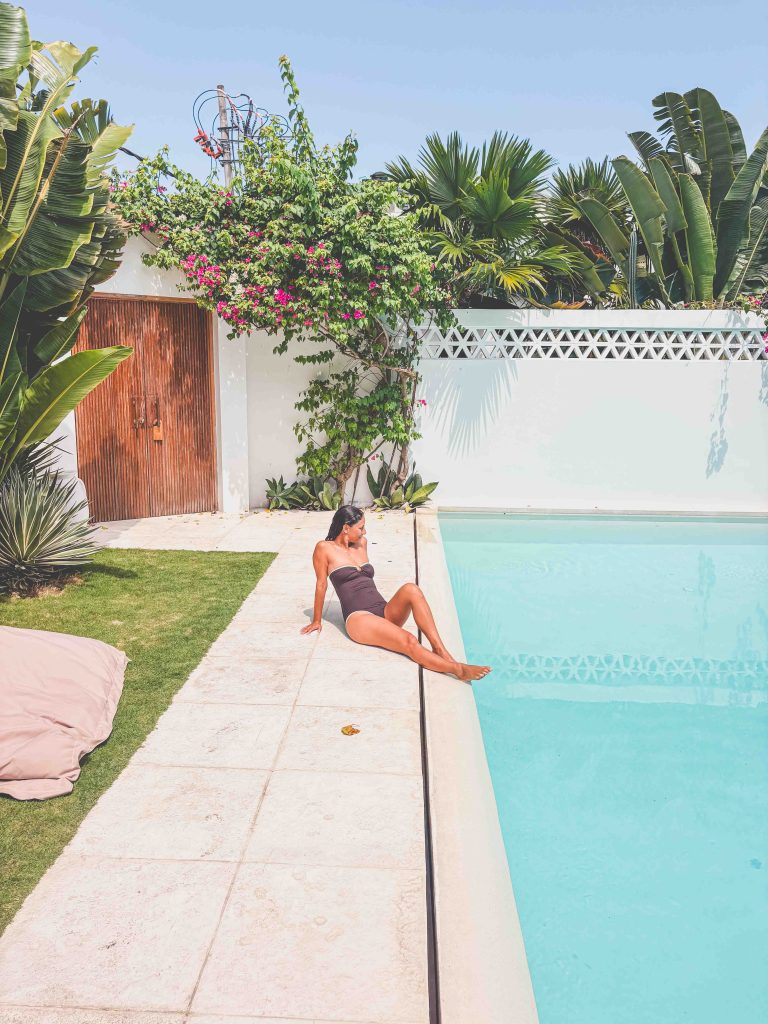
Beach and pool days. Most villas and hotels supply towels, so I skip the bulky beach towel and take one quick-dry travel towel for beach days and boat trips. Beach clubs, whether you’re after the best beach clubs in Uluwatu or a Canggu sunset day bed, usually have towels too, but ask first. The Uluwatu beaches are beautiful and also rocky, so water shoes make the steps and reef flats far less stressful.
Tip: Keep one set of swimmers, a sarong and a spare tee in your day bag at all times. Bali plans change in an instant, from a pool day to a surprise beach stop, and I’ve never regretted having them.
Shoes and swim checklist
- Flip-flops or slides
- Comfortable walking sandals with straps
- Closed shoes or old runners for waterfalls and rice fields
- Water shoes for rocky beaches (optional, but great for kids)
- 2–3 swimsuits per person (3–4 for kids)
- Rash vest or sun shirt
- Quick-dry travel towel
- Wet bag or plastic bags for damp swimmers
- Hat and UV-rated sunglasses
- Waterproof phone pouch
- Small dry bag for boat days and waterfalls
Toiletries, Sun Protection, Bugs and the Health Kit
Most hotels and villas supply shampoo, body wash and soap, and you can buy toothpaste, deodorant and basic toiletries at any minimarket. What I bring from home are the things I’m fussy about or can’t easily replace: my own sunscreen, my skincare, my contact lens solution, a hairbrush that doesn’t give up, and anything for sensitive skin. Hair behaves differently in humidity, so a good leave-in conditioner or hair ties are worth the space.
Sunscreen is the one thing I always bring from home. It’s easy to find in Bali, but imported brands can cost much more than at home, and the sun here is intense. I pack more than I think I’ll need, in reef-safe formulas when I can, and I reapply after every swim. A wide-brimmed hat, UV sunglasses and a lip balm with SPF cover the rest. Sunburn on day two can wreck an entire trip.
Mosquitoes are real. Dengue is present in Bali, and the mosquitoes that carry it are daytime biters, so repellent isn’t just for sunset. I use a repellent with DEET, picaridin or IR3535 and put it on in the morning like sunscreen. Light long sleeves and trousers help in the evenings, especially around rice fields in Ubud and Sidemen.
Tip for medications: Carry prescription medication in original packaging, with a letter from your doctor listing what it is and the generic name. Indonesia is strict about some medications, so check the current rules for yours before you fly rather than at the airport. Pack medication in your carry-on, never your checked bag.
Tip for stomach trouble: Almost everyone gets a dodgy tummy at some point, so I pack oral rehydration sachets and the anti-diarrhoea medication my own doctor is happy with. Apoteks are everywhere, but at 11pm in a villa up a hill you’ll be glad to have it already.
Toiletries and health checklist
- Reef-safe sunscreen (face and body), after-sun or aloe
- SPF lip balm
- Mosquito repellent
- Skincare and makeup you actually use, plus makeup wipes
- Deodorant, razor, hairbrush, hair ties
- Contact lenses, solution and a spare pair of glasses
- Tampons or pads if you’re particular about brand
- Prescription medication with a doctor’s letter
- Pain relief and antihistamines
- Rehydration sachets and the stomach medication you trust
- Plasters, antiseptic wipes and a small bottle of antiseptic
- Motion sickness tablets (boats and winding roads)
- Hand sanitiser and tissues
- Small zip bags for liquids
Tech, Documents and Money
Bali uses two-round-pin plugs (Type C and F) on 230V, so check your devices before you leave. If you’re coming from Australia, most of your chargers will handle the voltage, but you’ll need an adaptor. I pack a universal adaptor with USB ports and a small power board, because villas often have limited outlets and a family of four’s phones, iPads and cameras need charging all at once.
Tip: Download offline maps and your key bookings before you go. Cell coverage is great in the south and patchier in the hills. In Sidemen, the wifi was patchy in places, and honestly that was part of the charm. A power bank also saves you on long drive days when everyone’s phone is running a hot map and a hotter camera.
Money. I carry a mix of cards and cash. Have your bank confirm your card works overseas, and tell them your travel dates. Use ATMs inside banks or shopping centres rather than standalone machines on the street, and only use authorised money changers with clear rates posted. I keep small notes for tips, donations, parking and warungs, because change is a constant problem. Check your daily withdrawal limits, and what your bank charges for foreign transactions.
If you want to rent a scooter, make sure you have an international driving permit as well as your home licence, and check your travel insurance covers scooter accidents. Many policies don’t. With kids in tow we use a driver for most days, which is also easier on the nerves.
Tech, documents and money checklist
- Passport, e-visa confirmation, tourist levy proof
- Printed copies of bookings, insurance and flights
- Travel insurance details saved offline
- Two cards from different banks, plus some IDR cash
- Universal adaptor (Type C/F) with USB ports
- Mini power board or multi-input charger
- Power bank
- Phone with an eSIM installed
- Waterproof phone pouch
- Camera, spare memory card and charger, if you shoot
- Headphones and a downloaded playlist or shows for the flights
- Laptop and charger if you’re working remotely
- International driving permit if you’re riding or driving
Bags and How I Actually Pack
For most trips, one checked bag per adult and a decent carry-on backpack is all you need. A soft duffel or a suitcase with a bit of stretch beats a rigid case, because you’ll be lifting it in and out of cars and up and down steps, and a hard shell has no give. If you’re moving between regions, a bag that’s easy to lift in and out of a driver’s boot makes the whole thing less painful.
I pack with packing cubes, one for tops, one for bottoms and swimwear, one for underwear and sleepwear. When I’m changing villas every few nights, I can pull one cube out rather than turning the whole suitcase inside out. It also makes the “laundry run” a one-cube job.
Tip: leave space on purpose. Bali shopping is irresistible, from linen and rattan bags to ceramics and surf gear. Pack your suitcase two-thirds full on the way over, or pack a light foldable duffel inside it for the return trip. Weigh your bag before you leave and again before you fly home, because budget airlines can be strict about baggage allowances. Check your airline’s current limits before you buy anything big.
Tip: your carry-on is your insurance policy. If your checked bag goes missing, everything essential should be in the cabin. I pack a full change of clothes for each of us, medications, chargers, passports, a swimsuit, nappies and wipes if we have a baby, and snacks. With two small kids this has saved us more than once on delayed flights.
Bag checklist
- Checked suitcase or soft duffel, one per adult
- Carry-on backpack (hands free is easier with kids)
- Packing cubes
- Foldable duffel or tote for the return trip
- Day bag, ideally lightweight and water resistant
- Dry bag for boats, beaches and waterfalls
- Laundry bag
- Small luggage scale
- Luggage locks
Bali Packing List for Babies, Toddlers and Kids
Packing for Bali with kids is a different sport. The good news is that Bali is one of the easiest places in the world to travel with little ones: resorts are set up for families, staff adore children, and nappies, wipes and formula are easy to buy. The less good news is that brands, sizes and prices vary, and you don’t want to be hunting for your baby’s usual formula or a particular nappy size on arrival day. If you’re travelling to Bali with a baby, my rule is simple: bring enough of the essentials for the first few days, and buy the rest once you’ve settled.
Tip on the 2am problem: Bring a thermometer, a pain and fever reliever your child already tolerates, and oral rehydration sachets in your carry-on, not your checked bag. Kids get sick at the worst moments, and nothing is more stressful than trying to track down the right medicine at midnight in a strange place. Keep medication in its original packaging and check the label for your child’s age and weight. If you’re unsure of a dose, a pharmacist or doctor is the person to ask, not a blog.
Tip on car seats: Many drivers in Bali don’t have a child car seat, and Bali traffic is long and unpredictable. If you’ll hire a driver for day trips, ask in advance whether they can supply one, or bring a lightweight travel seat. It’s also handy on the plane for younger kids, so check with your airline.
Tip on strollers: Footpaths in Bali are patchy, uneven or non-existent. Our most-used item with little ones has been a baby carrier, with a compact, sturdy stroller as a second choice for airports and resort grounds. Leave the huge pram at home.
Tip on sleep: Most family-friendly resorts can provide a cot, but request it in advance, especially at busy times. A portable blackout blind, a sleep sack and a small white-noise machine make unfamiliar rooms feel familiar, and they fit in a corner of the bag.
Tip on swimming: You will spend an astonishing amount of time in the pool. Swim nappies, a well-fitting swim vest, a sun hat with a neck flap and a UV swimsuit for every child are worth bringing from home. Floaties and pool toys can be bought in Bali, but if your child has a favourite swim vest, bring it.
Baby (0–12 months) checklist
- Enough nappies and wipes for the first few days (more once you’ve found a local supermarket)
- Swim nappies
- Formula or bottles and sterilising kit, plus a travel kettle or flask if you need it
- Baby carrier
- Compact travel stroller
- Portable sleep setup: sleep sack, blackout blind, white noise machine
- Thermometer and baby-safe medication from home
- Baby-safe sunscreen and a wide-brimmed hat
- Muslin cloths and a change mat
- Baby monitor if you’ll be eating dinner out of earshot
- A few familiar toys
Toddler (1–3 years) checklist
- Swim vest, swim nappies or training swimmers, UV suit
- Hat with a chin strap
- Sippy cup or drink bottle
- Snacks you know they’ll eat (fussy eaters need a backup)
- Light travel car seat if you’ll be driving a lot
- Small backpack with a safety harness
- Soft toys, a couple of small books, a tablet with downloaded shows
- Spare clothes in the day bag, always
- Small first-aid kit
Kids (4+) checklist
- Two or three swimsuits and a rash vest
- Water shoes or sandals with grip for rocky beaches and waterfalls
- A hat and sunglasses
- A small backpack of their own to carry
- Colouring books, cards or a travel game for car rides
- A light jacket for the highlands
- A reusable water bottle
Tip: let the kids burn off steam. Kids who’ve been sitting in a car for two hours need somewhere to run. At Wapa di Ume Sidemen there’s a playground with a trampoline by the lake, and at Maimain Playground they can climb and explore. A tablet loaded with shows is plan B, but a playground stop is always plan A.
Planning where to stay? My picks for the best family resorts in Bali, including Merusaka Nusa Dua and Kayumanis Sanur, all make packing easier because the basics are on hand.
What I Over-Pack vs What I Never Travel Without
After 30-plus trips, the things I’ve stopped bringing say more about what works than the things I pack. This is the honest version of the list, and the one I wish someone had handed me on my first trip.
Things I used to over-pack (and have stopped)
- Too many shoes. Three pairs is the limit now. Heels and wedges never make it out of the suitcase.
- Jeans and heavy layers. Bali is a tropical island and the one cool evening in the hills calls for a light jacket, not a wardrobe.
- Full-size toiletries. Hotels supply the basics, and anything I run out of I can replace at a minimarket.
- Beach towels. Bulky, heavy, and nearly every villa and beach club has them. I bring one small turkish (thin) beach towel that Kylo uses as a blanket on the plane and then we have one in Bali just incase.
- A mountain of toys. One small bag per child. Shops and resorts fill the gap.
- A hairdryer and straightener. Check if your accommodation has one before you pack it, and if you’re shuffling between villas you may be fine with none.
- Too many “just in case” outfits. The 4-Day Rule exists because I broke it for years.
Things I never travel without
- A sarong. Temple cover-up, beach wrap, picnic blanket, baby sunshade, plane blanket.
- A small power board. One adaptor plus a board charges four phones and a camera at once.
- A waterproof pouch or dry bag. For boats, waterfalls, pool days and downpours.
- Our own sunscreen. Enough for the whole trip, with a spare tube in the day bag.
- A first-aid and sick-kid kit. Thermometer, pain and fever relief, rehydration sachets, plasters. You only miss it when you need it.
- An eSIM set up before we fly. The easiest start to any trip.
- Spare space. Because the best shopping always comes at the end.
What Not to Pack for Bali
Leaving things at home is half the art of packing for Bali. Here’s what I’d skip, and why.
- Expensive jewellery and watches. Not worth the worry, especially in villas, and nobody cares what you’re wearing.
- Heavy winter clothing and jeans. It’s tropical. A light layer is plenty, even in the hills.
- Single-use plastic. Bali has a serious waste problem and a reusable water bottle makes a real difference. Many hotels and cafes have refill stations.
- Drones, unless you’ve checked the rules. Regulations on flying drones in Bali can be strict, particularly near temples, airports and in protected areas. Check before you pack one.
- Anything illegal to import. Indonesia has strict drug laws, including for some prescription medications, and the penalties are severe. Check what you can bring in, and carry a doctor’s letter for anything borderline.
- A big camera kit you won’t use. If you’re not shooting for work, your phone will do the job and your shoulders will thank you.
- Too many books. Download them.
- Valuables you can’t afford to lose. If you do bring a laptop or camera, use a lockable bag and keep it with you.
Tip: If you have clothes at the end of their life, don’t throw them out before you leave. Plenty of local families would be glad to receive them. Ask your driver, villa staff or hotel team if they know someone who could use them, and it clears space for your shopping too.
What to Wear to Bali’s Temples
Bali is a Hindu island and the temples are active places of worship, not just photo stops. Shoulders and knees should be covered, and you’ll need a sarong and a sash (a waist tie) to enter most of them. Many temples lend or rent them at the entrance for a small donation, but I always carry my own because the borrowed ones are shared by hundreds of people a day and they’re often too short once you’ve got a toddler on your hip.
When we visited Pura Lempuyang from Sidemen, the sarong was compulsory and we were glad to have ours already in the bag. The same goes for Besakih, the mother temple on the slopes of Mount Agung. These are the days when you’ll want a lightweight top with sleeves, and a pair of shoes you can slip on and off easily because you’ll be taking them off a lot.
Tip: Tuck a sarong and a spare scarf into your day bag for the whole trip. You never know when a driver will say “let’s stop at this temple” and you won’t want to miss it. A sarong also covers sunburnt shoulders on the way home and works as a baby blanket, a beach towel or a sunshade for a pram.
Cultural note: Some temples ask women who are menstruating not to enter, and you’ll see signs saying so. It’s a long-standing local custom and worth respecting.
Temple checklist
- Sarong (lightweight, long enough to cover your knees when seated)
- Sash or waist tie
- Top that covers your shoulders
- Slip-on sandals
- Small day bag with a water bottle
- Small donation in cash (IDR 10,000–50,000 notes)
- Hat or scarf for the queue, because the sun is relentless at midday
My Bali Packing Essentials (Where to Buy)
These are the things I’d actually put in the cart before a trip. I’ve kept it to the items that earn their space, and I’ve written what to look for so you can choose the version that suits your budget and your bag. This section contains affiliate links, which means I may earn a small commission if you buy through them, at no extra cost to you.
Bags and organisation
- Packing cubes. The single best thing for living out of a bag across several villas. Look for a mixed set with a light mesh top so you can see what’s inside.
- Lightweight suitcase. Easier to load into a driver’s boot than a hard shell. Look for wheels, a sturdy handle and a bit of give.
- Lightweight day backpack. Water-resistant, with a front pocket you can reach in a hurry.
- Wet bag. Boat days, waterfall days, rain days. Kids
- Waterproof phone pouch. Look for one with a lanyard that fits your phone size, and test it in the sink first.
- Digital luggage scale. Saves you from paying overweight fees on the way home.
Sun, bugs and health
- SPF 50+ sunscreen. Look for broad-spectrum SPF 50, water-resistant, and a formula you’ve already tested on your skin.
- Mosquito repellent patches. DEET, picaridin or IR3535. A small pump spray or roll-on fits in a day bag.
- Compact first-aid kit. Pre-made kits save time, then add your own meds.
- Oral rehydration sachets. Cheap, tiny and very welcome when your stomach complains.
- After-sun gel or aloe. For the day you underestimated the sun. Can also get this in Bali but can be expensive.
- Reusable water bottle. Bali has a huge plastic problem. Bring your own water bottle and refill instead. Most villas and resorts have safe water dispensers.
Toiletries, skincare and hair
Humidity, sun and air-conditioning are hard on skin and hair, so these are the bits I’d rather not leave to chance.
- Your daily skincare. Cleanser, moisturiser, serum, whatever you actually use. Decant into small bottles so it doesn’t take over your bag.
- Laneige lip sleeping mask. Plane air and sun dry lips out fast, and an overnight mask fixes it by morning.
- Curl shampoo and conditioner. Bali humidity changes how curls behave, so bring the products you trust rather than gambling on a hotel bottle. Decant into travel bottles or buy travel sizes.
- Curl cream or leave-in conditioner. Helps with frizz and humidity, and it takes minimal space.
- Sheet face masks for the plane. A hydrating mask mid-flight, then another the night you land. Check your airline’s carry-on liquid rules.
- Face sunscreen. A separate face SPF that sits well under makeup, apart from your body sunscreen.
- Lip balm with SPF. One for the day bag, one in your hotel room.
- Cleansing wipes or micellar water. For the nights you’re too tired to do the full routine.
- Hydrating face mist. Great on hot days and in-flight.
- Body lotion and hand cream. Skin gets dry after sun, salt and pool water.
- Silicone travel bottles and a leak-proof set. Reusable and stops shampoo escaping into your clothes.
- Hanging toiletry bag. Handy in villa bathrooms with limited bench space.
- Hair ties, claw clips and a detangling brush. Satin or silk scrunchies are kinder to curls.
- Microfibre hair towel. Cuts drying time and frizz.
- Eye mask and earplugs. For the flight and light-filled villa mornings.
Tech and power
- Universal travel adaptor with USB ports. Make sure it covers Type C/F.
- Mini power board with a travel plug. One plug, five devices.
- Power bank. A reliable 10,000–20,000mAh bank is plenty for long driving days.
- Waterproof action camera. Optional, but brilliant for snorkelling off Nusa Lembongan and waterfall swims.
Clothing, shoes and beach
- Linen or cotton sarong. Choose a lightweight one in a neutral colour so it goes with everything.
- Packable rain jacket or poncho. Light enough to live in your day bag.
- Water shoes or sturdy sandals. For rocky beaches, waterfalls and rice-field walks.
- Quick-dry travel towel. Packs small and dries fast.
- Rash vest or UV swim shirt. Sun protection that doesn’t need reapplying.
- Wide-brimmed packable hat.
For kids and babies
- Swim vest. Fit matters more than brand. Choose one that suits your child’s weight.
- UV swimsuits and sun hats. Sun protection for kids that doesn’t rely on them standing still for sunscreen.
- Travel Pram. Hands-free through airports and uneven footpaths.
- Portable blackout blind. Makes unfamiliar rooms dark enough for naps.
- Travel white-noise machine. Small, rechargeable and a lifesaver for sleep.
- Kids’ backpack with a safety harness. For toddlers who bolt.
- Digital thermometer. One for the first-aid kit.
How Much to Pack by Trip Length and Season
Because laundry is cheap, the amount you pack barely changes once you’re past a long weekend. What changes is the number of regions you visit, and how much you’ll want to bring home. Packing lighter also helps your Bali trip cost, because excess baggage fees on budget airlines can add up quickly.
| Trip length | Clothing | Bags | Packing note |
|---|---|---|---|
| 3–4 days | 3 outfits, 2 swimsuits | Carry-on only is realistic | Skip the extras, buy sunscreen if you must |
| 7 days | 4–5 outfits, 3 swimsuits | Carry-on plus a small checked bag | One laundry run mid-trip |
| 10–14 days | 4–5 outfits (the 4-Day Rule), 3 swimsuits | One checked bag per adult | Two laundry runs, leave return space |
| 3 weeks or more | 4–5 outfits plus a few extras | One checked bag per adult plus a foldable duffel | Laundry every 4–5 days, shop as you go |
| Family of four, 2 weeks | 6 outfits per child, 4–5 per adult | Two checked bags plus carry-ons | Pack baby and toddler gear in its own cube |
Dry season (roughly April to October): pack for sun and heat, add a light layer for the hills and a poncho for the odd shower.
Wet season (roughly November to March): pack a proper rain layer, quick-dry clothes, and shoes that handle slippery ground. Rain usually comes in short, heavy bursts. Plan outdoor mornings and keep afternoons flexible. For more on timing your trip, see my Bali itinerary and Ubud itinerary guides.
Bali Packing FAQ
Do I need a jacket for Bali?
Probably not if you are only visiting the coast areas. However, I always take one for the plane. I get cold. I am then able to use that one when we travel further north to Munduk where the air (especially nights) are usually much cooler.
What should I wear in Bali as a woman?
Lightweight, breathable cotton or linen in dresses, shorts, skirts and tops is perfect for most places. Beach clubs, Canggu and Seminyak are relaxed. For temples, cover shoulders and knees and wear a sarong and sash. Bali is a Hindu island and temple dress matters.
Can I wear shorts and singlets in Bali?
Yes, in most of the tourist areas, beaches and cafes. Cover up for temples and when you’re walking through villages or visiting local ceremonies.
How many outfits do I need for Bali?
Four or five, for any trip length, because laundry is cheap and fast. Pack extra swimwear, because swimmers dry slowly in the humidity.
Do I need a voltage converter for Bali?
Indonesia runs on 230V with Type C and F two-pin plugs. Most modern phone and laptop chargers are dual-voltage, so you need an adaptor, not a converter. Check the label on anything with a heating element, like a hair straightener, because that’s where voltage mismatches cause trouble. I’ll say this, i’ve visited 30+ times and never used a converter. I do however, love packing a powerboard.
Is tap water safe to drink in Bali?
No. Drink bottled or filtered water, and use it for brushing your teeth too. Most hotels and villas supply refill or bottled water, and a reusable bottle cuts down on plastic.
Should I bring cash or cards?
Both. Cards work in most hotels, restaurants and shops in tourist areas, but small warungs, drivers, parking and temple donations are often cash. Withdraw from ATMs inside banks or malls and carry small notes.
Can I bring sunscreen on the plane?
If you’re flying carry-on only, liquids over the airline’s limit (usually 100ml per container) won’t make it through security. Put full-size sunscreen in your checked bag, and keep a small tube in your carry-on.
What should I pack for Bali with a baby?
Enough nappies, wipes and formula for the first few days, a baby carrier, swim nappies, a thermometer and medication you trust, a sleep setup and good sun protection. Everything else, you can buy once you arrive. My full list for travelling to Bali with a baby is above.
What should I not pack for Bali?
Expensive jewellery, heavy winter clothes, too many shoes and anything that can’t get wet when you’re on a boat or in the rain. See the “What Not to Pack” section above.
Planning the rest of your trip?
If you’re building your Bali plans, join our Facebook group for trusted recommendations on drivers, accommodation and kid-friendly spots. You can also read my guides to Sidemen, Munduk, Uluwatu, Canggu and Nusa Lembongan, so you know what you’re packing for.
Happy packing, and tell me in the comments what you never leave home without.
Found this post helpful? Pin and save for later!